Independent guide · every number sourced
Algae Cooking Oil: What the Evidence Actually Says
Algae cooking oil is a refined, neutral-tasting oil made from microalgae cultured in closed tanks; it involves neither seaweed nor seeds. Its fat is mostly oleic acid: the FDA lists the notified versions as 87% oleic acid 14. It is a cooking fat, not an omega-3 supplement.
By the editorial team · Updated 2026-11-25 · Every number linked to its source
Cooking oils compared
Use the oil table below to filter common cooking oils by fat profile and measured smoke point. Every value links back to the source it came from.
Tap a column to sort. Bars: green mono, amber saturated, blue poly.
Fats: USDA FoodData Central (g per 100 g); algae oil: FDA GRAS file (brand label says 93% mono, ~4% saturated). Smoke points: one lab's measurements (De Alzaa 2018); * = manufacturer claim. 123456
Want it on paper? The Cooking Oil Guide has all 15 oils on one printable page, with best uses and recipes.
Algae cooking oil showed up on grocery shelves with big promises: more good fat, less saturated fat, a very high smoke point and a smaller footprint than olive or avocado oil. This site is independent. Nobody here sells oil, and no brand's say-so counts as proof. We read the FDA safety files, Health Canada's assessment, USDA nutrient data and the few lab studies that exist, then sort each claim into three piles: confirmed, claimed by a manufacturer, and simply unknown.
Here is the short version, with links to the full pages.
What algae cooking oil is
The oil comes from single-celled microalgae, which Algae Cooking Club says are not harvested from nature but fed and grown in stainless steel tanks, a process it compares to brewing beer 7. The cells fill up with oil, are dried, and the oil is pressed out and refined the way other plant oils are 1.
The versions reviewed by regulators come from a microalga called Prototheca moriformis, in strains engineered to make mostly oleic acid 8. Algae Cooking Club, the main US brand today, has not said publicly which strain or producer it uses. For the full production story, read what algae oil is.
Algae cooking oil vs olive and avocado oil: the fat profile
Fat profile is where algae oil stands out. Two very different sources describe it, so both appear in the table. Values for the other oils are USDA grams per 100 g of oil.
| Oil | Monounsaturated | Saturated | Linoleic (omega-6) | Source |
|---|---|---|---|---|
| Algae oil, FDA dossier batches | 88.3% oleic | 8.1% | 1.5% | 1 |
| Algae oil, brand label claim | 93% omega-9 | 0.5 g per tbsp | under 3% | 2 |
| Olive oil | 73.0 g | 13.8 g | 9.8 g | 9 |
| Extra virgin olive oil | 69.2 g | 15.4 g | 8.4 g | 10 |
| Avocado oil | 70.6 g | 11.6 g | 12.5 g | 11 |
The two algae rows do not fully agree. The brand's 0.5 g per tablespoon works out to roughly 3.6% saturated fat, while the FDA dossier batches averaged about 8% 1. Nobody has explained the gap, and we found no independent lab test of retail bottles. Head-to-head pages: algae oil vs olive oil and algae oil vs avocado oil.
Smoke point: a manufacturer claim, not a measurement
Algae Cooking Club advertises a smoke point of up to 535°F 2.
A retailer blog about the same oil says 525°F 12, and the earlier Thrive brand quoted 485°F 13. No company has disclosed how it tested, and no outside lab has checked the figure.
Smoke point also predicts less than most people think. In one lab comparison, how stable an oil stayed under long heating mattered more than the temperature at which it first smoked 3. Details and a measured comparison are on the algae oil smoke point page, and a wider chart is in high smoke point oils.
Free printable guide · 14 pages
Get The Cooking Oil Guide
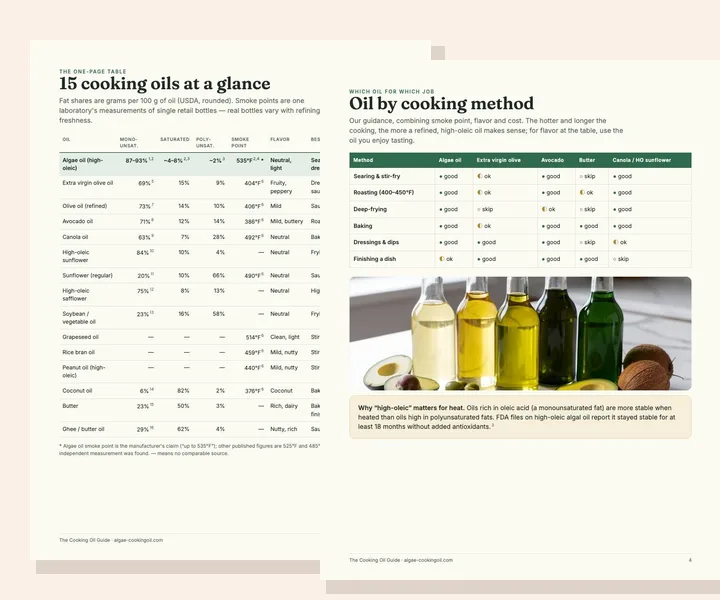
Get The Cooking Oil Guide: one page that lines up 15 oils by fat profile, sourced smoke point and best use, so you can pick the right bottle in the aisle.
- 15 oils on one page: fats, smoke points, best uses
- Which oil for searing, roasting, frying, baking, dressings
- Algae oil facts and open questions, with sources
- Label checklist, storage notes, 6 recipes · US Letter and A4
What the FDA has said
Two things are on record. First, the FDA reviewed GRAS (generally recognized as safe) notices for high-oleic algal oil and replied that it had no questions, in 2015 8 and again in 2018 14. A GRAS "no questions" letter is not an endorsement or an approval of a brand; it means the agency accepted the company's safety conclusion for the intended uses.
Health Canada reached a similar conclusion for the same oils 15.
Second, in 2018 the FDA allowed a qualified health claim for oils with at least 70% oleic acid, and high-oleic algal oil was among the oils named in the petition 16. The claim starts with "Supportive but not conclusive scientific evidence" and only applies when the oil replaces fats higher in saturated fat without adding calories. The exact wording and its limits are covered in is algae oil healthy.
How people cook with it
The brand describes the taste as light and neutral with a slight buttery note, and suggests it for searing, roasting, frying, baking and dressings, while saying it is not the oil to reach for when you want a finishing flavor 7. In practice it slots in wherever you would use a neutral oil. Techniques and swaps are in how to cook with algae oil.
It comes in aluminum bottles that block light 2. Shelf-life figures from the brand and a retailer do not match, so see how to store algae oil before you stock up.
Where it fits among other oils
Algae oil is often sold as an alternative to "seed oils." By origin it is not one, since it comes from microalgae rather than plant seeds, though the groups making that point have a commercial interest 17. The research on seed oils is more mixed than social media suggests; we walk through it in is algae oil a seed oil.
No single oil is the healthiest for every use. Our healthiest cooking oils page explains the criteria we use and where algae oil lands. If you want to try a bottle, where to buy algae cooking oil lists the stores that carry it and what to check on the label.
Open questions nobody has answered yet
Several basic facts are still missing from the public record:
- Which algae strain and which manufacturer stand behind the Algae Cooking Club bottle, and therefore whether it uses the genetically engineered strains described in FDA files.
- An independent lab analysis of the fatty acids in retail oil, which would settle the 93% vs 88% and 4% vs 8% questions.
- An independent smoke point test using a standard method.
- A third-party life-cycle study behind the brand's carbon claims. Its claimed carbon savings over olive, canola and avocado oil come with no cited study 7.
Until those gaps close, we label every figure on this site by where it came from: a regulator, a government database, a lab study, or a company selling the oil. We will update these pages when real data appears.
Helpful in the kitchen
As an Amazon Associate we earn from qualifying purchases. Optional; nothing on this page needs it.
The algae oil sold today in US stores; read the label claims alongside the FDA figures on this page.
See it on Amazon ↗A thin, even layer for roasting and air-frying, using less oil.
See it on Amazon ↗Frequently asked questions
Is algae oil safe to consume?
The high-oleic algal oils reviewed by the FDA received "no questions" letters under the GRAS program, and Health Canada judged them comparable in safety and nutrition to other food oils 15. Those reviews cover specific strains. The leading US brand has not said whether its oil comes from those strains, so the reviews support the ingredient in general rather than any one bottle.
Is algae oil a healthy cooking oil?
Its fat profile looks favorable: mostly monounsaturated oleic acid and very little omega-6. Oils with at least 70% oleic acid may carry an FDA qualified health claim, which the agency itself describes as supportive but not conclusive 16. What is missing is long-term research on algae oil itself, so treat it as one reasonable option rather than a health food.
What is algae extract called?
On food labels and in FDA files the cooking ingredient is usually called algal oil or algae oil. The FDA notes that using the term in its letters is not an endorsement of it as the official common name 18. The same words are also used for omega-3 supplements and for cosmetic ingredients, which are different products 19.
Which oil is good for daily use?
There is no single right answer. For everyday cooking, many people pick a neutral oil for heat and an olive oil for flavor. The FDA's qualified claim mentions roughly 20 grams a day of a high-oleic oil used in place of more saturated fats 16, and olive, high-oleic sunflower, safflower, canola and algal oils are all covered by it.
Sources
- U.S. FDA (notifier dossier by Burdock Group for TerraVia/Corbion), 2017: GRAS Notice (GRN) No. 754: Notification of GRAS Status of High-Oleic Algal Oil
- Algae Cooking Club, 2026: Algae Cooking Oil | Top Seller (product page)
- Acta Scientific Nutritional Health 2(6):02-11 (De Alzaa F, Guillaume C, Ravetti L; Modern Olives Laboratory Services, Australia), 2018: Evaluation of Chemical and Physical Changes in Different Commercial Oils during Heating
- USDA FoodData Central (SR Legacy), 2019: Oil, sunflower, linoleic, (approx. 65%) (FDC 171025)
- USDA FoodData Central (SR Legacy), 2019: Oil, safflower, salad or cooking, high oleic (FDC 171027)
- USDA FoodData Central (SR Legacy), 2019: Oil, soybean, salad or cooking (FDC 171411)
- Algae Cooking Club, 2026: FAQ (answers embedded in page data)
- U.S. FDA, GRAS Notice Inventory, 2015: GRN No. 527 - Algal oil (87% oleic acid) derived from Prototheca moriformis strain S2532
- USDA FoodData Central (SR Legacy), 2019: Oil, olive, salad or cooking (FDC 171413)
- USDA FoodData Central (Foundation): Oil, olive, extra virgin (FDC 748608)
- USDA FoodData Central (SR Legacy), 2019: Oil, avocado (FDC 173573)
- Thrive Market (A. Roberts), 2024: Algae Cooking Club algae oil (blog)
- Nutritional Outlook (J. Grebow), 2015: Will consumers accept algal oil as a cooking substitute?
- U.S. FDA, GRAS Notice Inventory, 2018: GRN No. 754 - Algal oil (87% oleic acid) derived from Prototheca moriformis strain S6697
- Health Canada, 2023: Novel Food Information: High Oleic Algae Oils from Prototheca moriformis strains S2532 and S6697
- U.S. FDA, 2018: Letter of enforcement discretion: qualified health claim, oleic acid in edible oils and reduced risk of coronary heart disease (Docket FDA-2017-Q-0807)
- Seed Oil Free Alliance (Seed Oil Free Certified), 2026: Is it a seed oil? Algae oil
- U.S. FDA, 2017: Response letter GRN 000677 - Algal oil (DHA) from Schizochytrium sp. strain ONC-T18 (Mara Renewables)
- Wikipedia, 2026: Seaweed oil (algae oil / algal oil)